"Dead" is not a diagnosis
When a computer stops responding, there are several reasons it might have happened, and they sit at very different points on the repair spectrum.
Sometimes the fix is straightforward: a faulty power switch, a charging port that's no longer making proper contact, or a battery that's completely discharged and won't hold a charge anymore. The machine looks dead, but the problem has nothing to do with your files. It's a mechanical or electrical issue, and once that's resolved, everything inside is exactly as you left it.
Other times, the screen itself has failed. The computer is actually running but not showing you anything. You might hear the startup sounds or see the keyboard backlight come on, but the display is dark. Again, your data is almost certainly untouched.
A more involved scenario is an operating system failure, where the computer powers on but can't complete the startup process. You might see an error message, a spinning wheel that never stops, or a screen that goes black partway through loading. This one takes more work to diagnose, but it still doesn't automatically mean your files are at risk.
When the hard drive is actually the problem
Hard drive failure is the scenario most people are imagining when they picture data loss, and it's the most serious on this list. A hard drive stores your files on magnetic platters or memory chips, and when it develops enough damage to stop functioning, it can take your data with it, sometimes without warning.
Even then, the situation isn't always hopeless. A drive that's failing but not completely gone may still allow a technician to pull most or all of your data before things get worse. The sooner it's looked at, the better the odds.
The silver lining most people don't know about
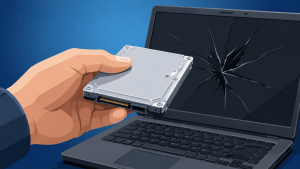
Here's what surprises a lot of people: even when the hardware around the drive has completely failed, the drive itself is often fine. A laptop with a faulty motherboard, a desktop with a dead power supply, or a machine that took a knock and stopped working; in many of these cases, the storage drive can be removed and connected to another computer to retrieve everything on it.
"Dead computer" and "lost data" aren't the same sentence, and one can be true without the other.
What not to do
The instinct to keep pressing buttons, try a different charger, or look up a YouTube fix is understandable, but it can make things harder to resolve. If there's any chance the drive itself is struggling, continued attempts to power the machine on can cause further damage. The same goes for taking the machine apart if you're not sure what you're doing.
What to do instead
Bring it in. A proper diagnosis takes the guesswork out of it entirely. You'll know what's wrong, what can be recovered, and what your options are, rather than finding out through trial and error. Most of the time, the news is better than people expect.